Welding Spacecraft Fuel Tanks – Merging Skill and Technology
03/12/2008
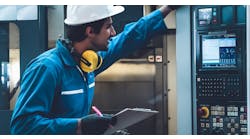
Welders performing a girth weld on a titanium tank. One welder is watching the weld of the tank in the chamber, while a second certified welder is monitoring the data on the computer console.
This titanium tank with 0.030 inch wall thickness is used as a liner for a Composite Over-wrap Pressure Vessel (COPV). Next step is installation of the composite over-wrap.
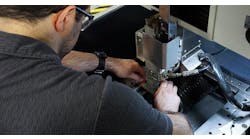
Welder fabricating PMD components with fresh air delivery helmet.

A typical communication satellite uses small rocket thrusters to maintain its position in orbit over its lifespan of more than 15 years.

Providing fuel to these “thrusters” throughout the life of the mission requires the marriage of clever design, and several manufacturing technologies and, welding is the make-or-break technology for the propellant tanks that carry the fuel. Propellant tanks look plain and unimpressive until one realizes their functional requirements.

Unlike fuel tanks on earth where gravity separates liquid fuel from vapors and puts the liquid at the proper opening, in space the forces of gravity are exactly counteracted by centrifugal forces to create zero gravity (more accurately called microgravity).

This prevents the liquid and vapor from being in a predictable location inside the tank. When a thruster is fired, the liquid in the tank suddenly is sloshed in the opposite direction of the thrust, and this might move the available fuel away from the outlet and cause the thruster to starve for fuel or ingest gaseous propellant, either of which would prevent proper operation of the multimillion-dollar spacecraft. Along with the need to provide liquid propellant continuously, the tanks must be extremely lightweight while maintaining safety factors for long duration use, and they must survive the accelerations and vibrations that are the rigors of launch into space. In a failure, the tanks must leak rather than burst. To make the tanks light, the walls are egg-shell thin. Typical spacecraft propellant tanks have a working pressure of 360 PSI and only have a wall thickness of 0.035 in.

Hamilton Sundstrand’s Space Land and Sea operation in Long Beach, California designs and builds spacecraft propellant tanks using a blend of the latest technologies and old-world craftsmanship. The welders use a combination of manual, semi-automatic, and automatic welding to produce the various structures and components that make up a flight propellant tank. This article provides an overview of the welding portion of the manufacturing process.

Before welding
Hamilton Sundstrand’s tanks begin as a flat sheet of titanium, which is spinformed to near-net-shape. After spinning and various thermal processes, the cups are precision machined on both the ID and OD to final dimensions. The thickness and profile are controlled to within 0.001 in., with nominal final wall thicknesses on the order of 0.030 in. to 0.050 in. After machining and non-destructive examination, the domed parts are cleaned and prepared for welding.

The tanks can be assembled as one of three variations. They can be assembled “empty” for use as a xenon tank for xenon ion propulsion, units. They can be assembled with metal or elastomeric bladders for positive expulsion. Or, they can be assembled with a propellant management device (PMD) that uses surface tension of the fuel to collect and separate the liquid fuel and deliver it to the external manifold system.

The propellant management device is a structure made of formed sheet, sheets and tubes that have hundreds of thousands of laser drilled holes in them, and other highly machined titanium components.

Each of these types of tanks must pass rigorous functionality tests along with traditional non-destructive examination before they are kitted for assembly by welding. Once a kit is ready, the components are cleaned.

“The key to successfully welding of titanium is cleanliness.” according to Wayne Tuttle, manager of welding development for Hamilton Sundstrand. Tuttle oversees both the welding and preparation operations associated with fabrication of spacecraft tanks.

All parts undergo a multi-step, proprietary cleaning process that uses acetone, alkaline soap and hot deionized water, among other cleansing products. Some arc welding processes also require acid etching, and special chemicals to dissolve residue from in-process penetrant inspection. The cleaning processes are part of the qualified process of welding, and are carefully controlled and monitored for strict adherence to the procedures. Even drying the parts is controlled. Jets of argon are used to remove surface water rather than shop air, which might have traces of oils that could contact the clean surfaces. Once cleaned, the parts are whisked away to the cleanroom where they will remain until after welding is completed.

Where to weld
Propellant tanks and propellant management devices are fabricated in a state-of-the-art cleanroom designed specifically for welding. According to Tuttle, normal cleanrooms are used for electronic devices or medical products for which low humidity would be a problem.

The welding cleanroom at Hamilton Sundstrand was designed to dramatically reduce humidity so that surface moisture could be kept to a minimum. The main assembly area is a 1,400 square-foot class 10,000 cleanroom with a complete air exchange every 2-½ minutes and at least 25 percent fresh (outside) air added to the air stream. This room contains three manual welding stations, glove boxes, computer-controlled orbital and tube-sheet welders, and a computer-controlled circumferential welder with remote wire articulation in a large (>250 cu. ft.) inert atmosphere chamber. Also, all tooling and tools used in the fabrication are stored inside the cleanroom to prevent contamination. This well-lit, well-ventilated “welding shop” was specially built for this application, and has a significant role in ensuring that the titanium parts made for spaceflight are defect free.

While some observers initially think that this might be overkill, Larry Isom, program manager for the spaceflight propellant tanks, points out that a single weld defect can turn a $200,000 tank into $20 of scrap for these critical parts. Because of the thin wall thicknesses and internal shape and spacing requirements, repair and rework usually are taboo.

“It has to be right the first time, or it is scrap and the customer’s launch schedule will suffer. These products must undergo ‘special non-destructive examination for fracture critical flight hardware,’ and there is no room for error or compromise,” Isom said.

How to weld
Almost all flight welding done in house at Hamilton Sundstrand is gas tungsten arc welding (GTAW). All titanium is welded with high purity argon using either a chamber or local purge dams. All purging is tested for compliance with their requirement of < 20 ppm O2 and dew point less than –65 F. “Many facilities require the use of high purity gasses, but we monitor and measure it in situ to ensure that the atmosphere at the weld is perfect before we ever strike an arc. Then, during welding operations, the gas purity is monitored continuously and alarms will sound if the moisture or oxygen levels change. The light straw color that many welders think represents high-quality titanium welding would never be accepted here. It must be bright silver with no change in coloration.” Tuttle said.

The propellant management device is assembled first. Specialized tooling is used to fixture and locate the component parts and assists in purging. Most propellant management devices are too large and complex to weld in a glovebox, so special purge boxes and tooling are used to ensure perfect weld coverage.

Using these boxes produces a great deal of argon directed at the face of the welder, so Hamilton Sundstrand pioneered the use of helmets with fresh air ventilation to improve welder comfort and assurance of perfect breathing atmosphere.

Many of the propellant management device subcomponents are assembled within a glovebox, but many parts also must be welded using only local purging. Because the nature of a downdraft cleanroom is to be drafty, the welders at Hamilton Sundstrand must take extra care to maintain purge coverage for the irregular parts they weld in the open.

Once the propellant management device is welded together, it must be fitted to the rest of the tank. These devices depend on wicking action and surface tension to function, so precise spacing and locations of their various arms and channels must be set.

“There is no easy way to do this other than the deft skill of an experienced welder,” according to Tuttle. He says fitting and adjusting a propellant management device is a throwback to the art of a blacksmith, where precise heat application is used to move and warp parts to set them in precise locations.

“The blacksmith of old did not use feeler gauges, and neither did he use a TIG torch, but the underlying process is the same. This is an area for which there is no substitute for a welder’s experience. This is not a job for a new trade school graduate. The welders doing this work each have more than 25 years of welding experience,” Tuttle said.

Finally, the propellant management device is ready and installed in a cart-mounted circumferential welding system. This unique custom system and its tooling holds the parts with joint fit-ups that are required to be better than 0.005 mismatch total indicated runout. Then, inspectors are brought into the cleanroom to verify that the setup is correct. Once the inspectors approve the setup, the welder is released to weld the part. The welder slides the cart into the chamber and the door is sealed. A programmable logic control runs the chamber and its automated vacuum and fill systems to ensure a perfect welding atmosphere. The argon gas that fills the chamber is circulated continuously and dried to ensure the best weld quality. The gas also is monitored continuously for dew point and trace oxygen levels.

The girth weld on the tank is made by state-of-theart, computer controlled welding equipment. The computer controls the weld current, rotation speed, wire feed and arc voltage. The welder remotely controls the wire entry to the pool, and monitors the weld for any required override of welding parameters.

Tuttle points out that precision welding requires providing skilled welders with the right tools and procedures, and letting them use their judgment during the weld to control the fine details of the weld within predefined limits defined in the weld specifications.

During the weld, the computerized system monitors and records all welding parameters one thousand times per second. The system alerts the welder to any out of tolerance conditions during the weld, and provides written documentation of the weld’s compliance with the qualified settings. Post processing of the data includes statistical process control (SPC) and reports that indicate the health of the welding system.

The example given is typical, but every design has its own nuances and process optimization. While titanium is the most common material used for these tanks, Hamilton Sundstrand also manufactures tanks and composite overwrap pressure vessels liners from aluminum and stainless steels to the same exacting specifications and requirements. All welding done at Hamilton Sundstrand is certified and performed to AWS D17.1:2001.

RATE THIS ARTICLE
Not Interesting Interesting
COMMENTS :
Tools:
Email a Colleague
Print This Article
Reprints/Licensing